RoboticsRobot manipulationStory 06
GloVLA explained: geometry moves, AI handles contact
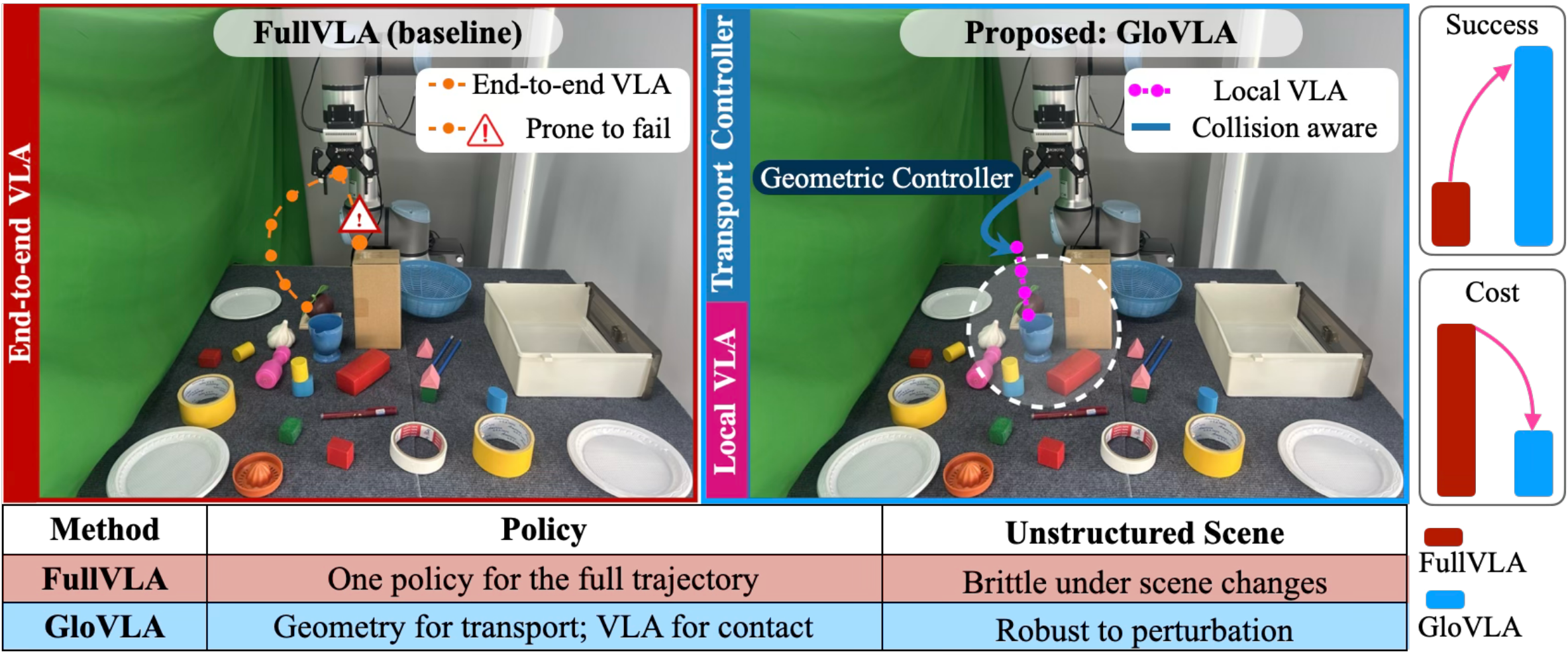
The short answerGloVLA divides a robot-manipulation task between a geometric controller for moving into position and local vision-language-action policies for the interaction. It is a hybrid research method, not a new consumer robot.
The useful part
Why it matters
The result challenges the assumption that one learned policy must handle every moment of a task. Our reading: sometimes the interesting advance is choosing where to use AI, not asking it to do everything.
Worth doing
Do you need to do anything?
Watch for the handoff between movement and contact in the project material. For everyday readers this belongs in the watch category, not on a shopping list. Check the paper before interpreting a success percentage as general reliability.
Why separate movement from manipulation?
The authors describe a geometric transport controller that takes the gripper to a handoff region. A local VLA policy handles the short interaction phase. They evaluate simulation tasks with visual and environmental changes and a physical UR10e robot. The paper reports improved success and reduced VLA inference cost under its conditions.
Think of reaching a handle, then turning it
As an analogy, getting your hand near a handle and adjusting your grip while turning it are related but different jobs. That does not mean GloVLA has been tested on every handle. The analogy simply explains why a designer might divide a movement instead of handing the whole sequence to one policy.
A useful question for the next robot headline is therefore: what job did the learned system actually perform? A shorter role can still be an important contribution. Describe the division of work before deciding what the demo says about AI generally.
How much does the demonstration prove?
The arXiv record identifies a research submission; it is not independent verification by Read The Day. We have not reproduced the results. Look up the task definitions, trial counts and comparison setup before extending the claims to unfamiliar objects or unsupervised operation.
Evidence
Primary source
AI-assisted editorial explanation, checked against the linked documentation on 14 September 2026. Examples labelled as illustrations are ours; no independent product test or reproduction is claimed. The original newsletter remains unchanged. Our editorial standards.