RoboticsOpen robot AIStory 04
OpenWAM-α explained: what robots learn from video
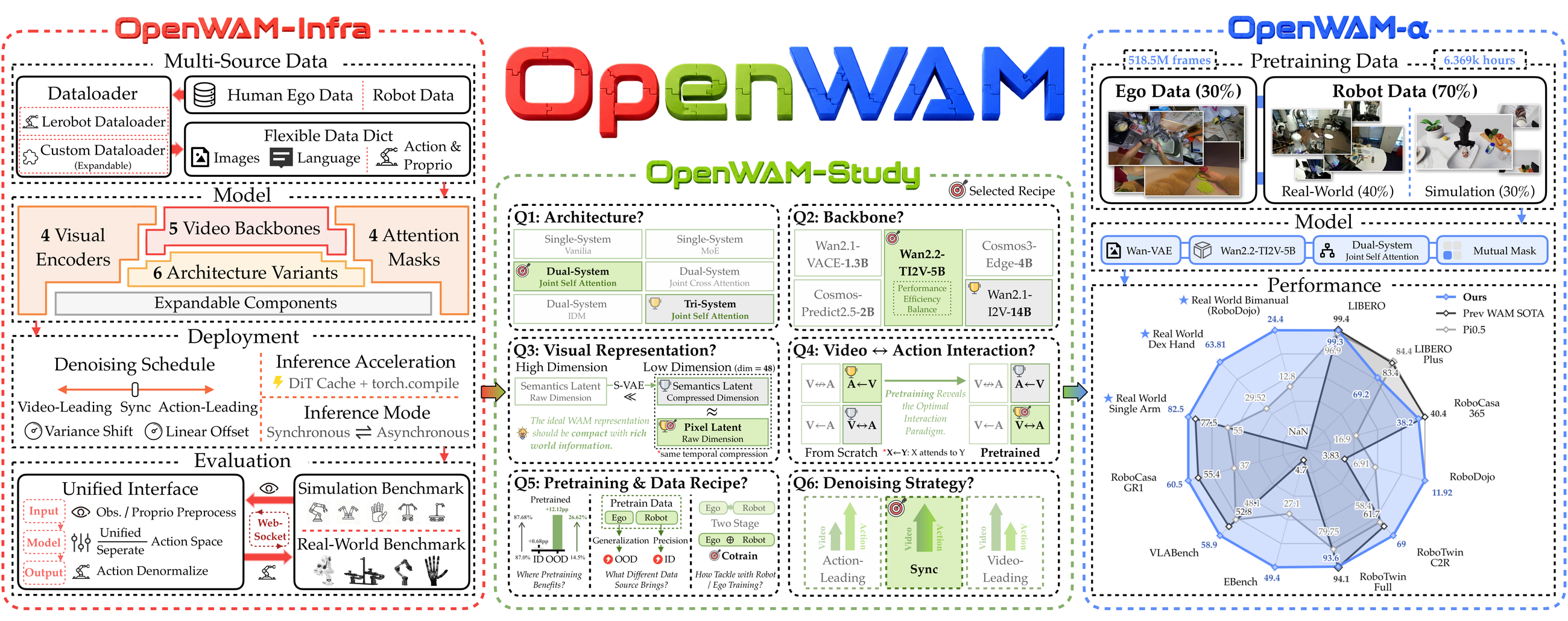
The short answerOpenWAM is a research stack for studying how predictions about the world can support robot actions. OpenWAM-α, also written OpenWAM-alpha, is the model built from that stack's experimental findings.
The useful part
Why it matters
A robot needs more than an attractive prediction of the next scene: it has to choose a movement. Our takeaway is the attempt to connect those jobs in a way other researchers can inspect, not a promise that a household robot is suddenly ready.
Worth doing
Do you need to do anything?
Curious readers can watch the project overview and check what the experiment actually tests. Researchers should start with the linked infrastructure and evaluation material. You do not need to install a model to understand the development.
OpenWAM, OpenWAM-Infra and OpenWAM-α: what is the difference?
The authors distinguish a modular infrastructure, a controlled study of design choices and the resulting pretrained model. They describe roughly 6,400 hours of human and robot video, with evaluation across eight simulation benchmarks and three real-robot platforms. These are the team's reported results.
Source: OpenWAM: official project, experiments and release links
Predicting a scene is not the same as moving a robot
Imagine asking a robot to put a cup on a shelf. A predicted picture of the cup on the shelf would not tell us whether the hand reached it without a collision. This is our illustrative example, not an OpenWAM test. It separates two questions: what might happen, and which action gets us there?
When watching the demo, note the task, the robot and the conditions. Then look for those same conditions in the evaluation. A compelling clip can be worth watching without answering every question about reliability.
What remains unproven?
We have not reproduced the experiments. Results on the reported setups do not establish dependable operation in an arbitrary home. Use the authors' linked project and paper to identify this release; similarly named projects should not be treated as interchangeable.
Evidence
Primary source
AI-assisted editorial explanation, checked against the linked documentation on 14 September 2026. Examples labelled as illustrations are ours; no independent product test or reproduction is claimed. The original newsletter remains unchanged. Our editorial standards.